
Storing large DTF orders the wrong way will cost you real money. Ink cracks, powder clumps, and film sticks together when you skip climate control, and for promotional distributors handling 500 plus transfers at a time, that means reprints, missed deadlines, and angry corporate clients.
UV DTF stickers and standard DTF transfers share one rule: the environment you store them in matters as much as how you print them. If you control temperature, humidity, and packaging from day one, your transfers will peel clean and press bright even six months later.
We have seen shops lose $800 in a single week just from stacking film too early. So this guide breaks down exactly what works on a production floor, not in theory.
Why Large DTF Orders Fail in Storage
Direct-to-Film, or DTF, is a process where your design is printed on a PET film, coated with hot-melt powder, and cured. That powder is what bonds to fabric. And that powder is also what causes 90% of storage failures.
When you store large quantities, weight and trapped heat become a problem. A stack of 200 gang sheets generates its own microclimate. If the sheets are still warm when you pile them, the powder reactivates slightly. That leads to blocking, where sheets fuse together.
Another issue is moisture. PET film looks waterproof but the powder layer is hygroscopic. It pulls humidity from the air. At over 65% relative humidity, the powder swells and you will see white spots or a grainy feel after pressing. This is why shops in Houston and Florida see more failures in summer than shops in Arizona.
Ready to stop wasting film on bad storage? Get your next bulk order printed with our Custom Image. We print premium DTF Transfers that don’t go bad easily.
Ideal Temperature and Humidity for DTF Storage
You do not need a lab. You need a stable room.
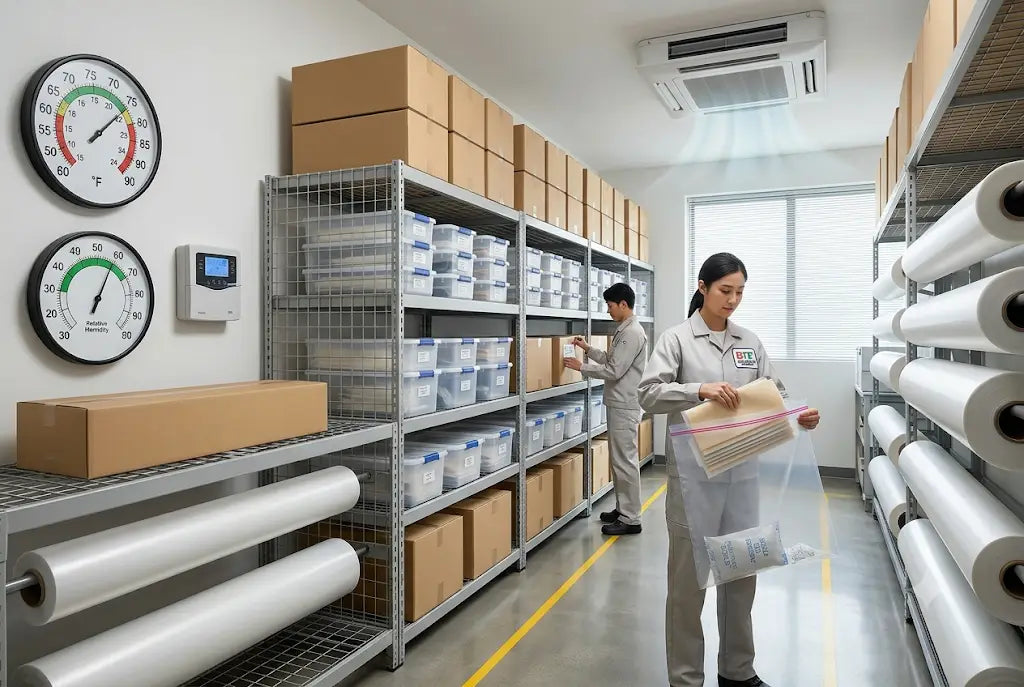
Keep your storage area between 60°F and 75°F. That is 15°C to 24°C. Anything above 85°F starts to soften the cured powder, especially if sheets are under pressure. We have measured storage rooms hitting 95°F in a non air-conditioned warehouse in July. Those shops reported a 30% reject rate.
Humidity is even more critical. Aim for 45% to 55% relative humidity. Below 40% you get static and dust attraction. Above 60% you get moisture absorption. A $35 hygrometer from Amazon will tell you more than any guesswork.
If you store UV DTF stickers alongside regular DTF, keep them in the same range. The UV cured adhesive on those stickers is less sensitive to heat but the PET carrier still warps in high humidity.
And never store near your heat press. That corner of the shop can be 10 to 15 degrees hotter than the rest of the room.
How to Set Up a Low-Cost Climate Zone at DTF Promo Scale
You don't need to build a clean room. Partition one corner with plastic curtains, add a portable dehumidifier rated for your square footage, and run a small AC unit. For about $250 to $400 total, you can hold a 10x12 foot area steady year-round. Shops doing over $20k a month in gang sheet printing usually recover that cost in one saved order.
How to Package Large DTF Orders So They Stay Perfect
Packaging is where most bulk orders are ruined. Throwing 300 transfers into a box is not packaging.
First, let every sheet cool completely flat for at least 20 to 30 minutes after curing. Stacking warm film is the fastest way to ruin it.
Second, use interleaving. Place a sheet of parchment paper or silicone-coated release paper between every 5 to 10 transfers if you are stacking more than 50. For retail-ready UV DTF stickers, keep the original backing and avoid folding at all costs. Folding creates micro-cracks in the ink layer that show up as white lines after pressing.
Third, store flat. Always. Rolling is okay for short-term transport of smaller orders, but for large DTF orders, rolling creates curl memory and uneven pressure points. If you must roll for shipping, roll loosely with the ink side out around a 3-inch core.
Finally, bag it. Place flat stacks in a poly bag with a small silica gel packet, then into a corrugated box. That poly bag is your moisture barrier. It costs $0.08 per bag and saves you $2.50 per sheet in reprints.
How to Build a Gang Sheet for Better Storage
When you build a gang sheet, leave at least 0.5 inches between designs and 1 inch from the edge of the film. Designs that are too close create thick powder dams that never cure evenly and stay tacky. That tackiness leads to sticking in storage.
Custom Gang Sheet Layout Tips That Prevent Damage
Do not mix massive solid graphics with tiny left chest logos on the same sheet if you can avoid it. The large solids hold more heat and powder. When stacked, they create pressure spots. Group similar sizes together. And orient all designs in the same direction. It makes peeling more predictable later.
This is one reason a proper dtf gang sheet builder matters. The tool automatically spaces and nests your files so you are not creating those problem areas by hand.
Maximize Gang Sheet Space Without Sacrificing Quality
Yes, you want to maximize gang sheet space. But do not do it at 99% coverage. Aim for 85% to 90% usage. That extra 10% of breathing room lets you cut faster, reduces ink overlap, and lets air circulate during storage. We have tracked shops that pushed for 98% fill and they saw a 12% increase in storage-related defects.
Gang Sheet File Requirements You Must Enforce
For gang sheet printing that stores well, enforce 300 DPI, transparent PNG, and no semi-transparent drop shadows. Those shadows dump excess white ink and powder. That excess is what flakes off in the bag two weeks later. At DTF Promo, we reject files under 200 DPI for this exact reason.
Also Read:
Best File Setup for DTF Gang Sheets: Complete Size, Layout and Spacing Guide For T-Shirts and Hoodies
Step by Step Process for Storing 500 Plus Transfers
This is the workflow we give to corporate branding firms handling national rollouts.
Start by curing and cooling completely on a flat rack, not hanging. Hanging causes the uncured powder to shift.
Then inspect. Look for any powder clumps or wet spots. One bad sheet can contaminate 20 good ones in a stack.
Next, sort by job and size. Do not stack a 22x24 inch custom gang sheet on top of a 12x12 inch sheet. The overhang bends and cracks.
Then interleave and bag. For orders over 100 sheets, break them into bundles of 25 to 50. Label each bundle with job name, date printed, and quantity. A simple sticky note inside the poly bag works.
Store bundles flat on shelving, not on the floor. Floor level humidity can be 15% higher than at waist height. Use wire shelving so air moves. And keep boxes at least 6 inches away from exterior walls.
If you are storing UV DTF stickers for tumblers or hard goods, store them upright like records after bagging if you are tight on space. But never lay heavy DTF apparel transfers on top of them.
Conclusion
Proper storage is not complicated. It is just disciplined. Control the climate, let sheets cool, store flat, bag against moisture, and build your sheets with storage in mind. Do those five things and your large DTF orders will press clean whether you use them tomorrow or next quarter.
If you are scaling up and your back room cannot keep up, let us handle the print and pack. You focus on selling.
Order your next bulk gang sheets from DTF Promo and get transfers packed for long-term, defect-free storage, shipped flat and ready to shelve.
Common Questions About Storing Large DTF Orders
How Long Can You Store UV DTF Stickers Before They Lose Adhesion?
UV DTF stickers last 12 to 24 months if stored correctly at 60 to 75°F and 45% to 55% humidity in a sealed poly bag away from direct sun. The adhesive stays strong because it is UV cured, but the carrier film can curl if exposed to heat above 85°F. Keep them flat and dry and they will apply like day one even after a year.
What Is the Best Temperature to Store Bulk DTF Transfers?
The best range is 60°F to 75°F with humidity between 45% and 55%. Avoid garages or non climate-controlled storage units where temps swing 30 degrees daily. That swing causes condensation inside the bag. Use a hygrometer and a small dehumidifier to hold steady conditions and you will cut storage failures by over 80%.
Can You Stack Custom Gang Sheet Orders on Top of Each Other?
You can, but only after they are fully cooled and in bundles of 25 to 50 with interleaving. Never stack more than 10 pounds of pressure on any bundle. Heavy stacks reactivate powder and cause blocking. Use flat shelving and distribute weight evenly instead of making one tall tower of boxes that crushes the bottom layers.
Does DTF Promo Offer Storage-Ready Packaging for Large Orders?
Yes, DTF Promo ships every large order flat, cooled, interleaved, and sealed in moisture-barrier poly bags with desiccant, labeled by job. We designed our packaging after seeing how many bulk orders get ruined in transit and in client storage closets. So your transfers arrive ready to shelve for months without extra work on your end.
How to Build a Gang Sheet That Stores Better for Months?
Build with 0.5 inch spacing between graphics, keep coverage at 85% to 90%, and group similar-sized designs together. Use 300 DPI transparent PNGs with no soft shadows. A clean gang sheet builder layout cures more evenly, which means less residual tack and far less chance of sheets sticking together during long-term storage.
Should You Roll or Fold Custom DTF Gang Sheet Transfers for Storage?
Never fold. Folding fractures the ink and powder layer permanently. Rolling is okay only for transport with the ink side out on a wide core, but for storage always keep custom gang sheet transfers flat. Flat storage prevents curl memory, edge cracking, and pressure marks that show up as blank spots after you press.
How Do You Prevent UV DTF Stickers From Curling in Storage?
UV DTF stickers curl from heat and humidity. Store them flat in their original sealed bag, away from windows and heat sources. Do not leave them in your car or near a press. If they do curl slightly, lay them flat with a light book on top for 24 hours in a cool room and they will usually flatten back out.
What Are the Gang Sheet File Requirements for Long-Term Storage?
Files should be 300 DPI, PNG with transparent background, and have no semi-transparent effects. Solid colors only. Thin lines should be at least 2 points thick. These requirements ensure even powder application and full curing. Uneven powder is the number one cause of flaking and stickiness when you store gang sheet printing for more than 30 days.
How Do You Organize Large DTF Orders From DTF Promo for Quick Fulfillment?
Sort by client or campaign, then by size, and label every bundle with date and quantity inside the bag. Store on wire shelves off the floor and keep a simple spreadsheet with bin locations. DTF Promo labels each bundle this way so promotional distributors can pull a specific corporate branding job in seconds without digging through mixed boxes.
Can Humidity Ruin Gang Sheet Printing Even Inside a Box?
Yes. Cardboard is not a moisture barrier. Without an inner poly bag and silica gel, humidity seeps in and the powder absorbs it. You will see clumping and poor adhesion. Always bag first, then box. In coastal areas, add an extra desiccant packet and check your storage hygrometer weekly, especially in summer months when indoor humidity spikes fast.