
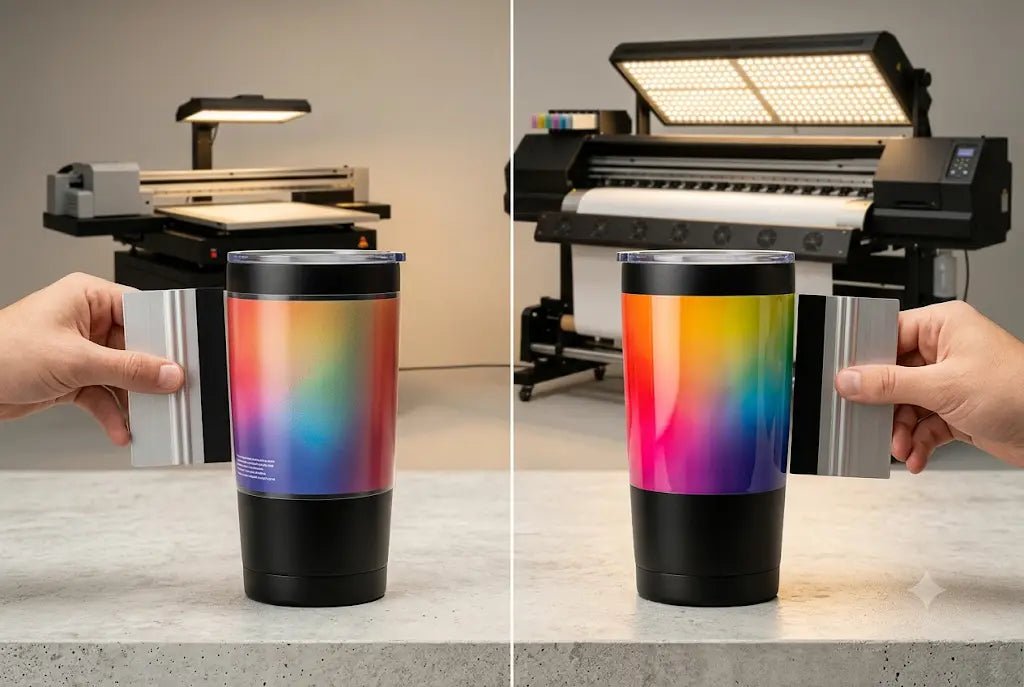
If a shop is trying to decide between the Hyper+ Version and standard UV DTF, the real issue usually isn’t technical specs—it’s whether the business is actually ready to support the added complexity with consistent, high-value order flow. Most operators start by comparing print samples, but that’s only a snapshot under ideal settings, not a reflection of daily production where humidity shifts, rush orders pile up, and file quality varies from customer to customer.
In real production environments, both systems produce sellable output. The difference shows up in margins, setup discipline, and how well the shop matches equipment to actual order types. Hyper+ tends to reward shops that already have structured pricing tiers and consistent demand for high-detail or photo-heavy work. Standard UV DTF, on the other hand, stays more forgiving when job types are mixed and volume swings between bulk logo runs and small custom orders. The gap isn’t just visual quality; it’s operational rhythm. One system tolerates inconsistency, the other starts costing money the moment workflow drifts.
We have prepared tis guide to help print shops, apparel brands, and merch shops device whether to upgrade to a 9-color system.
Hyper+ vs Standard UV DTF: What’s Actually Being Compared
The Hyper + is a multi-channel UV DTF system designed to expand tonal range using additional ink channels beyond standard CMYK setups. Most configurations include light cyan, light magenta, and extended gamut inks for smoother gradients and improved photographic reproduction.
Standard UV DTF relies on a simpler ink structure (typically 4–6 channels) optimized for speed, stability, and lower consumable cost.
The trade-off is clear:
- More channels = better color precision
- Fewer channels = easier production control and lower cost
Hyper+ Features in Real Production Conditions
Expanded Ink Channel Architecture
The Hyper + features typically include up to nine ink channels, allowing smoother gradients and better tonal transitions in skin tones, product mockups, and branding visuals.
In production terms, this shows up as:
- Reduced banding on gradient-heavy artwork
- Cleaner photo reproduction on rigid substrates
- Better color separation in complex designs
But calibration becomes significantly more sensitive compared to standard UV DTF systems.
Ink Cost Reality (2025 Market Averages)
Based on supplier pricing across major US and Asia distributors:
- Standard UV DTF ink: $35–$60 per 500ml
- Hyper+ ink: $45–$85 per 500ml
Per A3 print consumption:
- Standard UV DTF: $0.18–$0.35
- Hyper Plus: $0.25–$0.55
That difference becomes significant at scale. At 2,000 prints/month, ink alone can differ by $150–$400 monthly.
Film + Curing Sensitivity
Both systems use A/B transfer film, but the Hyper + technology requires tighter environmental control.
Recommended operating range:
- Temperature: 20–25°C
- Humidity: 45–60%
Outside that range:
- Adhesion inconsistency increases
- Edge lifting becomes more common on curved surfaces
- Color shift becomes noticeable in dense prints
Standard UV DTF Technology: Why It Still Dominates Entry-Level Shops
Standard UV DTF remains the most widely adopted setup among new print shops, Etsy sellers, and small customization businesses.
Typical entry setup cost:
- Printer system: $3,500 – $8,000
- Starter ink set: $300 – $700
- Film supply: $80 – $150 per roll set
- UV curing unit: $400 – $1,200
Total entry point: under $10,000 in most cases
Why it still wins:
- Faster onboarding
- Lower maintenance frequency
- Easier ICC profile management
- More forgiving print environment
Where it falls short:
- Limited gradient smoothness
- Less premium finish perception
- Reduced color depth on photo-heavy work
Hyper + Applications (Where It Actually Pays Off)
The Hyper+ applications are not universal. It performs best in:
- Premium product branding (cosmetics, boutique packaging)
- Automotive decals with gradient fades
- High-detail portrait stickers
- Drinkware customization (tumblers, bottles, glassware)
- Small-batch luxury merchandise
It is less efficient for:
- Bulk logo stickers
- One-color branding runs
- High-volume low-margin Etsy orders
Side-by-Side Production Breakdown
|
Category |
Hyper Plus |
Standard UV DTF |
|
Ink channels |
7–9 colors |
4–6 colors |
|
Setup difficulty |
High |
Low |
|
Color accuracy |
Very high |
Moderate |
|
Ink cost per print |
$0.25–$0.55 |
$0.18–$0.35 |
|
Maintenance load |
Frequent tuning |
Stable |
|
Learning curve |
Steep |
Beginner-friendly |
|
Output positioning |
Premium market |
Mass/custom market |
Case Study: Dallas Print Shop Workflow Split
A composite case based on multiple consulting interventions documented through DTF Promo production.
A small print operation in Dallas, Texas, ran two UV DTF machines producing Etsy stickers and drinkware decals. Monthly revenue averaged $14,000, with net margins around 18%.
The shop introduced one Hyper + unit alongside its standard UV DTF setup.
Initial challenges:
- Ink waste increased by roughly 22%
- Color calibration required nearly 10–14 days
- Operator errors increased during profile adjustments
Workflow adjustment:
- Hyper+ assigned to premium, high-detail orders
- Standard UV DTF retained for bulk production
- Pricing tiers adjusted upward for premium output
After 60 days:
- Revenue increased to $18,600/month
- Net margin improved to 27%
- Ink waste normalized after workflow separation
The key factor was not equipment performance—it was job segmentation.
Hyper + Benefits That Show Up in Real Shops
- Wider tonal range for photographic work
- Stronger perceived product value
- Reduced post-print correction work
- Better acceptance in boutique branding markets
These advantages only matter when the pricing structure supports them.
Hyper Plus Technology Limitations
Operational constraints consistently observed:
- Higher sensitivity to humidity changes
- More frequent calibration cycles
- Increased downtime during maintenance
- Higher replacement part costs
- Steeper training requirements for operators
Where DTF Promo Fits Into Production Decisions
DTF Promo is frequently used in workflow planning for print shops scaling UV DTF operations. We typically focuses on:
- Matching machine type to order distribution
- Preventing overinvestment in underused color channels
- Structuring pricing tiers around production capability
- Reducing ink waste through job segmentation
Final Verdict: Is Hyper+ Worth It?
The Hyper+ makes financial sense only when demand consistently requires high-color fidelity work that can be priced accordingly.
Standard UV DTF remains the more stable option for most entry-level and mid-volume shops due to lower operating cost and simpler workflow management.
Equipment capability should follow order demand; not the other way around.
Explore a range of UV DTF printing solutions at DTF Promo.
Frequently Asked Questions
What is Hyper+ used for in UV DTF printing?
It is used for high-detail UV DTF applications requiring expanded color range, especially in gradient-heavy designs, product branding, and premium custom merchandise where visual accuracy is important. It is mainly chosen for high-end prints that demand richer color reproduction.
How much does Hyper Plus printing cost per item?
Typical cost ranges between $0.25 and $0.55 per print depending on ink density, artwork complexity, and substrate type. Standard UV DTF is usually cheaper per unit, making it more suitable for bulk production and low-cost everyday printing jobs.
Is UV DTF still profitable compared to Hyper Color systems?
Yes. Standard UV DTF remains highly profitable due to lower ink consumption, simpler maintenance, and faster production cycles. It performs especially well for bulk orders, sticker businesses, and platforms like Etsy where speed and cost efficiency matter most.
Does Hyper + improve print quality significantly?
It improves gradient smoothness, color depth, and photographic accuracy. However, the difference is most noticeable in complex or premium designs. For simple graphics, standard UV DTF often delivers similar results without the added cost or processing complexity.
What is DTF Promo in UV DTF workflow planning?
DTF Promo is a consulting and training resource that helps print shops optimize production flow, pricing strategies, and equipment usage. It focuses on improving efficiency, increasing profit margins, and building scalable workflows for UV DTF businesses.
Can Hyper+ run standard UV DTF jobs?
Yes, it can handle standard jobs, but it may be inefficient. It uses more ink and requires additional calibration, making it less cost-effective for simple designs. It is better suited for premium or highly detailed print work.
What are the biggest risks of upgrading to this technology?
The main risks include higher operating costs, complex calibration, and underutilization if there are not enough premium orders. Small shops may struggle to justify the investment if demand for high-end, color-intensive prints is inconsistent.
How long does UV DTF printing take per batch?
Most A3 UV DTF prints take around 3–6 minutes depending on coverage and design complexity. Hyper Color systems may take slightly longer due to additional color processing and enhanced layering required for higher-quality output.
Which is better for Etsy sellers: standard UV DTF or Hyper+?
Standard UV DTF is generally better for Etsy sellers due to lower cost per item and faster turnaround. Hyper Color systems are more suitable for premium listings where customers are willing to pay higher prices for detailed artwork.
Is Hyper+ worth upgrading for small shops?
It is only worth it if there is consistent demand for premium, high-detail prints. Otherwise, standard UV DTF offers better ROI, easier operation, lower costs, and more stable profitability for small or growing print businesses.
Note: This post was prepared by UV DTF experts at DTF Promo who have years of experience in print production consulting, machine calibration, and shop workflow optimization, supporting print businesses across entry-level setups and high-volume production environments with practical, real-world operational insight.