
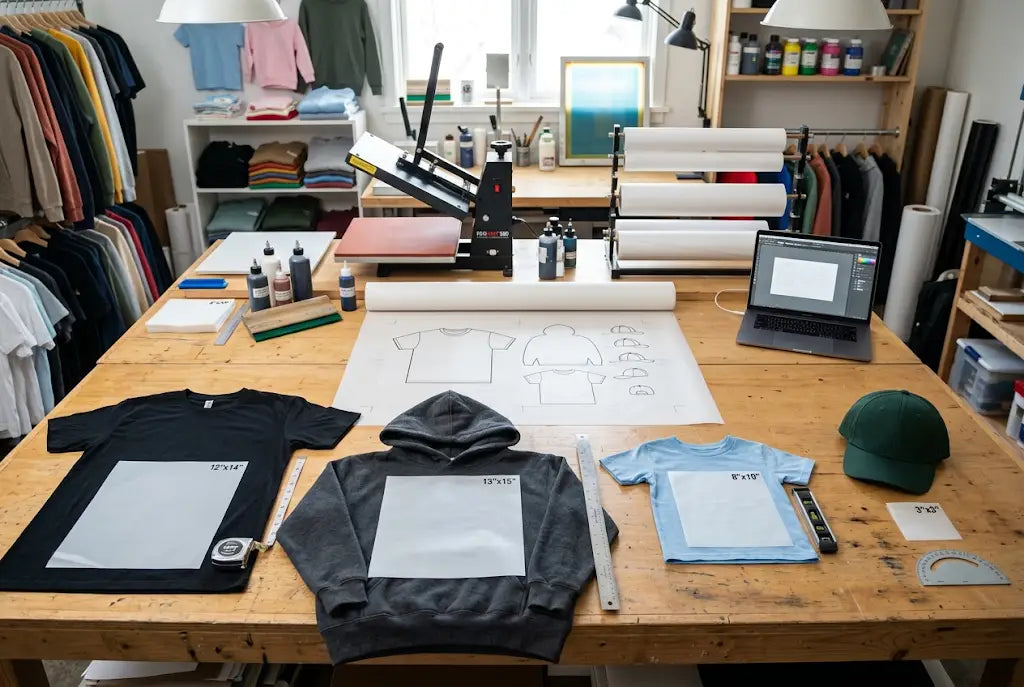
Ordering one DTF gang sheet for everything sounds easy, until your t-shirt print looks perfect and your kids tee and hat logos don't fit or look off.
That's because apparel size changes the math. A standard adult t-shirt needs an 11-inch front, a hoodie needs a 12-inch back to look balanced, a youth shirt only needs 6 to 8 inches, and a hat front is just 4.25 inches wide. If you calculate your sheet size using one number for all of them, you'll overpay for blank film or come up short on prints.
In this post, we'll show you how to calculate gang sheet size for t-shirts, hoodies, kids apparel, and hats. You'll learn the exact print sizes that sell, how many fit on a 22x24, 22x60, and 22x120, and how to mix them on one sheet to save money.
Keep reading to get the cost analysis and layout tips for your next order.
What a DTF Gang Sheet Is and Why Apparel Type Changes the Math
A DTF gang sheet is one large PET film sheet with multiple designs printed together. You pay for the sheet size, not per design. So you can mix logos, sizes, and art on one sheet and cut them apart later. That's why promotional distributors love it for corporate orders with many sizes.
But apparel type changes everything. A t-shirt back print is 11 inches wide. A kids shirt is 7 inches. A hat front is only 4.25 inches. If you calculate your gang sheet size using t-shirt numbers for a kids order, you'll order a sheet twice as big as you need. And if you use kids' numbers for hoodies, nothing will fit. So you have to calculate by garment first, then pick your sheet.
Standard DTF Gang Sheet Sizes and What They Really Fit
Most shops sell DTF gang sheet sizes in four standard widths. 22x24 inches, 22x36 inches, 22x60 inches, and 22x120 inches. Usable print area is about 0.5 inches less on each side because printers need a margin. So a 22x24 gives you about 21.5x23.5 inches of real space.
Pricing in 2026 is pretty consistent. A 22x24 runs $10 to $15, a 22x36 runs $16 to $22, a 22x60 runs $22 to $32, and a 22x120 runs $38 to $55. You pay whether you fill it or not. A 22x24 is 528 square inches. A 22x60 is 1,320 square inches. If you leave 30% blank, you're throwing $3 to $9 per sheet in the trash. For agencies ordering 50 sheets a month, that's $150 to $450 of waste you can get back.
Common Gang Sheet Sizes for Promo Orders
For promo distributors, 22x60 is the workhorse. It fits 10 to 12 adult full fronts plus a handful of left chest logos if you nest right. For corporate branding firms doing employee packs with t-shirts, hoodies, and hats, two 22x60 sheets often cover a 48 piece order with all placements included. Kids-only orders usually fit on a single 22x24 or 22x36 because the art is so much smaller.
Just Exploring? Browse our DTF gang sheet sizes and see real layout examples for t-shirts, hoodies, kids, and hats. Or Build a Gang Sheet.
How to Calculate Gang Sheet Size for T-Shirts
T-shirts are your baseline. Most adult promo tees use three placements. Full front at 11x11 inches, full back at 12x12 inches, and left chest at 4x4 inches. Some corporate clients want a 4.5x4.5 inch chest for better visibility. Always confirm.
To calculate gang sheet size, you can't just use the design size. You need to add gap space. Use 0.25 inches between designs minimum so powder doesn't bridge and cause a hard edge when you peel. So an 11x11 becomes 11.25x11.25 in your math. That small addition changes count fast.
Adult T-Shirt Print Sizes That Sell Most
For marketing agencies ordering for events, 10x10 inches is the safest full front. It fits small through 2XL without looking too big or too small. For left chest, 4x4 is standard, 4.5x4.5 for workwear and retail brands that want the logo to pop. For sleeve prints, 3.5 inches wide is the sweet spot. These sizes are based on thousands of promo orders and they keep reprint requests low because they work across sizes.
How Many T-Shirt Prints Fit on One DTF Gang Sheet
Let's do real numbers. On a 22x24 DTF gang sheet with usable space of 21.5x23.5, you fit 4 prints at 11x11. That's it. On a 22x60 with usable 21.5x59.5, you fit 10 prints at 11x11 if you place them in two columns of five. You fit 24 prints at 4x4 on a 22x24. And you fit 60 prints at 4x4 on a 22x60. If you know how to build a DTF gang sheet by staggering rows like bricks, you can add 2 to 3 extra prints per sheet. That is where you maximize DTF gang sheet space without shrinking art.
How to Calculate Gang Sheet Size for Hoodies and Sweatshirts
Hoodies change the math because prints get bigger. A hoodie has a thicker fabric and a larger chest area, so a 10 inch print looks small. Most promo distributors order 12x12 for hoodie backs and 11x11 for fronts. For left chest on hoodies, 4.5x4.5 or even 5x5 looks more balanced than a tiny 4x4.
And hoodies need more heat press pressure, so your transfer needs clean edges. If you pack hoodie prints too tight with only 0.125 gap, powder can clump and you'll get a rough edge that shows on fleece. Use 0.5 inch gap for hoodie backs.
Why Hoodies Need Larger Prints and Different Placement
A t-shirt full back is usually 3 inches below the collar. A hoodie full back is 4 to 5 inches below the hood seam to avoid the thick seam. That means your art placement is lower, but your print size should be bigger to stay visible. For a 22x60 DTF gang sheet, you only fit 8 prints at 12x12 instead of 10 at 11x11. So a 48 piece hoodie order with front and back prints needs about 12 sheets of 22x60 if you do fronts and backs separately, or about 8 sheets if you nest a 4.5 inch chest into the gaps beside the 12 inch backs. That nesting saves about $88 to $120 per 48 piece order at current pricing.
How to Calculate Gang Sheet Size for Kids Apparel
Kids apparel is where you win back film. Youth sizes are much smaller, so your DTF gang sheet size can be much smaller too.
A youth small full front is 8x8 inches. Youth medium is 9x9. Youth large is 9.5x9.5. Left chest for kids is 3x3 or 3.5x3.5. Many corporate family events order kids shirts with 6x6 prints because it looks better proportioned on a small shirt. If you use adult math for kids, you will over-order by a lot.
Youth Sizing Chart for DTF Gang Sheet Layout Tips
Use this as your guide for DTF gang sheet layout tips for kids. Ages 2-4, use 6x6 front. Ages 5-8, use 8x8 front. Ages 9-12, use 9x9 front. For left chest on all kids sizes, 3x3 to 3.5x3.5 is perfect. On a 22x24 sheet, you fit 9 prints at 8x8. On the same sheet, you fit 20 prints at 6x6. On a 22x60, you fit 24 prints at 8x8 and 48 prints at 6x6. So a 24 piece youth order with 8x8 fronts fits on one 22x60 with room left for extra logos. That same order in adult sizing would need two sheets.
One small mistake costs a lot here. Kids shirts are often 50% cotton 50% poly. DTF works great on that blend, but you must keep cure temp consistent. That's not a sizing issue, but it matters for promo distributors who press mixed fabrics on the same job.
How to Calculate Gang Sheet Size for Hats and Small Promo Items
Hats are the smallest standard apparel item. A standard hat front is 4.25 inches wide by 2.25 inches tall. Some Richardson 112 style hats allow up to 4.5 inches wide. Beanies are similar. Bags and tote small pocket prints are 4x4.
For hats, your gang sheet size calculation is all about quantity. You can fit a lot.
Hat Press Limits and Film Use
A hat press is only about 6x8 inches, so your transfer must be small and curved to fit. Use 4.25x2.25 as your max. With 0.25 gap, each hat logo needs about 4.5x2.5, or 11.25 square inches. A 22x24 sheet is 528 square inches. Divide 528 by 11.25 and you get 46 hat logos per sheet, but with margins you realistically get 36 to 40. A 22x60 sheet gives you 96 to 104 hat fronts.
That's why promotional distributors doing 100 hats should never order multiple small sheets. One 22x60 covers it at about $24 to $28, or $0.25 to $0.29 per hat transfer. If you ordered four 22x24 sheets at $12 each, you'd pay $48 for the same count and double your cutting time.
How to Build a DTF Gang Sheet for Mixed Apparel Orders and Maximize DTF Gang Sheet Space
This is where most agencies lose money. They order separate sheets for t-shirts, separate for hoodies, separate for kids, separate for hats. Four orders, four shipping charges, four times the film waste.
You can build one DTF gang sheet that covers an entire employee pack.
Mixing T-Shirts, Hoodies, Kids, and Hats on One Sheet at DTF Promo
Here's a real promo example. 24 adult tees need 4.5 inch left chest, 12 hoodies need 12 inch back, 12 kids tees need 8 inch front, and 24 hats need 4.25x2.25 front.
Instead of four sheet sizes, you build two 22x60 sheets. Sheet one: place six 12 inch hoodie backs in two columns, that's 3 per column. That uses about half the sheet height. In the gaps beside them, nest twelve 4.5 inch chest logos for the tees. Now you have hoodies and tees covered on one sheet.
Sheet two: place twelve 8 inch kids fronts, that's 6 per column in two columns. That uses half the sheet. Fill the remaining space with 24 hat fronts. You can fit 24 hat logos in about 14 inches of length when placed 4 across. So one sheet covers kids and hats.
Total: two sheets, $48 to $56, covering 72 apparel pieces with four different sizes. If you ordered each size separately on 22x24 sheets, you'd need about six sheets at $72 plus extra cutting time. You just saved $20 to $30 and an hour of labor. That's how you maximize DTF gang sheet space for real corporate orders. And DTF Promo does this nesting for you if you send all art together.
Conclusion
Calculating gang sheet size by apparel type is not extra work. It's how you stop overpaying. T-shirts need 10x10 to 11x11 for fronts, hoodies need 12x12 for backs with bigger gaps, kids need 6x6 to 8x8, and hats need 4.25x2.25. Measure each design with a 0.25 inch gap added, add up your total square inches, and pick the smallest DTF gang sheet sizes that fit without forcing you to cut giant rolls for tiny orders. Mix sizes on one sheet whenever you can. That one habit cuts film waste by 25 to 35% and drops your cost per transfer below a dollar for small logos.
Need help sizing your next mixed promo order? The team at DTF Promo will lay it out tight so you get more prints per sheet and fewer reprints on press.
Frequently Asked Questions About DTF Gang Sheet Sizing for Apparel
How Do I Calculate DTF Gang Sheet Size for T-Shirts?
Measure your print at press size, add 0.25 inches for gap, multiply width by height. A 10x10 becomes 10.25x10.25 with bleed, plus gap is 10.5x10.5. Divide your usable sheet area by that number. A 22x24 sheet has about 505 usable square inches, so you fit 4 prints at 11x11. Always add 15% extra for spacing when doing bulk t-shirt orders.
What Size Should My DTF Gang Sheet Be for Hoodie Back Prints?
For hoodie back prints at 12x12, use a 22x60 DTF gang sheet if you need more than 6 prints. A 22x24 fits 2 prints at 12x12, a 22x36 fits 4, a 22x60 fits 8, and a 22x120 fits 16 with 0.5 inch gaps. For best results, keep 0.5 inch gap between large hoodie prints so powder cures evenly and the edge peels clean on fleece.
How Many Kids Prints Fit on a DTF Gang Sheet?
Kids prints are smaller, so you fit more. On a 22x24 DTF gang sheet you fit about 20 prints at 6x6, 9 prints at 8x8, and 36 prints at 4x4 left chest. On a 22x60 you fit about 48 at 6x6 and 24 at 8x8. Always use youth sizing, not adult sizing, when calculating gang sheet size for kids to avoid ordering double the film you need.
What Is the Best Gang Sheet Size for Hat Logos?
The best gang sheet size for hat logos is 22x60 for orders over 36 hats and 22x24 for under 36 hats. A standard hat front is 4.25x2.25 inches. With gaps, you fit 36 to 40 on a 22x24 and 96 to 104 on a 22x60. This makes your cost per hat transfer about $0.25 to $0.33, which is ideal for promo distributors.
How Do I Build a DTF Gang Sheet With Different Apparel Sizes?
To build a DTF gang sheet with different apparel sizes, place large hoodie backs first, then fill gaps with t-shirt left chest logos, then fill remaining corners with kids or hat logos. Sort art by size before layout, keep 0.25 inch gaps for small prints and 0.5 for large, and push art to the printable edge to maximize DTF gang sheet space.
Can I Mix T-Shirts, Hoodies, and Hats on One DTF Gang Sheet?
Yes, you can mix t-shirts, hoodies, and hats on one DTF gang sheet and you should. This is how you maximize DTF gang sheet space for promo kits. Place 12 inch hoodie backs in columns, nest 4.5 inch t-shirt chest logos beside them, and tuck hat logos in leftover corners. DTF Promo specializes in these mixed promo layouts for agencies.
How Do I Maximize DTF Gang Sheet Space for Promo Orders?
You maximize DTF gang sheet space by cropping PNGs tight to art edge, using 0.25 inch gaps instead of 0.5, staggering rows like bricks, and mixing large and small designs. Never leave transparent padding around logos. Shops that trim files and nest properly fit 30% more per sheet, which saves $200 to $400 per month on film for regular promo orders.
What DTF Gang Sheet Layout Tips Work Best for Corporate Branding Firms?
The best DTF gang sheet layout tips for corporate firms are group by size zone, keep consistent gaps, and label designs by garment type. Place all left chest logos together for fast cutting, all full fronts together, and all hat logos together. This reduces press errors and speeds up fulfillment when you have to sort 100 plus transfers for different apparel types in one order.
Does DTF Promo Help Calculate Gang Sheet Size for Different Apparel?
Yes, DTF Promo helps calculate gang sheet size for different apparel including t-shirts, hoodies, kids, and hats. Send us your design sizes and quantities and we will recommend the exact DTF gang sheet sizes you need and nest them for maximum fill. We work with promotional distributors and marketing agencies daily to cut film waste and keep cost per piece low.
How Much Does a DTF Gang Sheet Cost for a Mixed Apparel Order?
A mixed apparel order with 24 tees, 12 hoodies, 12 kids, and 24 hats typically needs two 22x60 DTF gang sheets at $22 to $32 each, so $44 to $64 total. That covers 72 pieces with all placements. If you ordered each apparel type on separate small sheets, cost jumps to $70 to $90 plus extra labor. Mixing sizes always costs less per piece.