
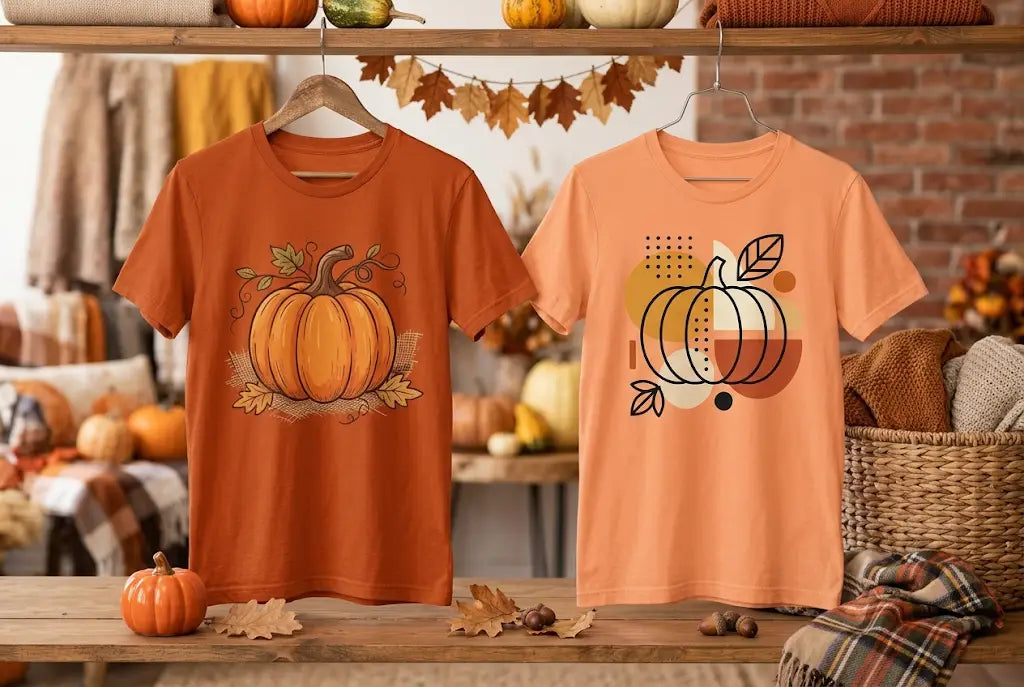
Some pumpkin shirts sell out in a week. Others sit in a bin until November. The difference is rarely the pumpkin itself. It is the style around it, the blank it is printed on, and the buyer it was made for. When those three line up, pumpkin shirts move fast. When they do not, even cute art gets ignored.
Classic pumpkin art feels warm, familiar, and a little worn in. Modern pumpkin art feels clean, bold, and made for a photo. Both can work. But they do not attract the same buyer, and they do not sell at the same price.
Classic promises comfort. Modern promises style. If you know which promise your buyer wants, you know what to stock.
This comparison looks at look, fit, buyer intent, and printing, with the mistakes to avoid when using DTF transfers and the checks to run before you press a batch.
Nostalgia vs. Minimalist: Decoding What Your Autumn Apparel Customers Want
Buyers do not buy a pumpkin. They buy a feeling. Classic buyers want a memory. Modern buyers want a look. If you mix those up, your listing will feel off, even if the art is good.
What Classic Buyers Are Really Buying
Classic buyers want warmth. They want a shirt that feels like a pumpkin patch, a porch with mums, a kitchen that smells like cinnamon. They are often 28 to 58, and they shop early, usually late August through September. They buy for themselves, for their kids, and as gifts.
- They buy for feeling, not for trend: A classic pumpkin tee does not need to be new. It needs to feel familiar.
- They buy in groups: Family matching sets, school fall festivals, and church harvest events all lean classic.
- They care about softness: A classic shirt that feels stiff gets returned. It has to feel soft from the first wear.
This works well because classic art lowers the risk for the buyer. They already know they like this style. They have worn it before. They are not guessing.
What Modern Buyers Are Really Buying
Modern buyers want a clean, put-together look. They are often 20 to 38, and they buy for style. They want a shirt that looks good in a photo and goes with jeans, a cardigan, or a blazer. They shop later, often late September and October, once the weather actually turns.
- They buy single shirts, not sets: Modern buyers are less likely to buy matching family sets. They buy one shirt that fits their taste.
- They buy for everyday wear: Modern pumpkin shirts get worn to work, to brunch, and to school drop-off.
- They care about fit and fabric: A modern design on a boxy, stiff tee will not sell. It needs a soft, well-fitting blank.
And they judge fast. If the thumbnail looks busy, they scroll past. If it looks clean, they click.
Cute vs. Funny: Two Different Kinds of Want
Cute and funny are not the same buyer, even when the pumpkin looks similar.
Cute pumpkin shirts win on charm. A pumpkin with a bow, a smiling face, a tiny leaf, or a checkered pattern feels sweet without being childish. They photograph well, they give well, and they work for a wide age range. They are a strong fit for pumpkin shirts for women because they fit everyday wear.
- Best cute details: Bows, hearts, gingham, smiley faces, and small flowers. Keep them simple so they print clean.
- Best colors for cute: Soft orange, dusty pink, cream, and sage. These colors feel sweet without looking like a costume.
- Best placement for cute: Center chest or full front. Cute art needs to be seen right away.
Funny pumpkin shirts sell fast and burn out fast. A joke that lands in September feels tired by late October. That does not mean you should skip funny. It means you should stock it in smaller runs and price it to move.
- Best funny phrases: Keep them short and clean. "Pumpkin Spice and Everything Nice," "My Favorite Season," or "Creep It Real" work because they are easy to read from a few feet away.
- Best colors for funny: Black and charcoal make funny art pop. White works too if the text is bold enough.
- Best timing for funny: Order funny art in late September. Order classic and cute art in August.
Funny shirts also get shared more online. A buyer who laughs is more likely to tag a friend. That share can drive a quick spike, but it will not carry you through the whole season.
How Pumpkin Patch Shirts and Fall Graphic Tees Fit In
Fall graphic tees and a pumpkin patch shirt sit between classic and modern. They can lean either way, depending on how you style them.
- For a classic fall tee: Use a pumpkin patch scene, a truck with pumpkins, or a harvest basket. Keep the colors warm and the texture light.
- For a modern fall tee: Use a single pumpkin, a leaf, or a coffee cup with a pumpkin. Keep the colors tight and the space open.
- For both: Test the art on the actual blank. A design that looks sharp on a mockup can look soft on a real shirt.
Pumpkin patch shirts sell because they solve a photo problem. Parents want five matching shirts that look good together in a pumpkin patch photo. They do not want to hunt for five sizes in five different designs.
High Volume or Higher Margins? How Pumpkin Design Styles Impact Your Bottom Line
Volume feels good. Margin pays the bills. Classic gives you one. Modern gives you the other. The shops that last do both.
Why Classic Drives Volume
Classic pumpkin shirt designs sell in bundles. A family of five does not buy one classic shirt. They buy five. A teacher buys ten for a fall party. A market buyer buys three as gifts. That volume adds up fast.
- Family sets sell in bundles: Price the set as a bundle. A bundle feels like a deal to the buyer and saves you time on pressing and packing.
- Gifts sell without much selling: A classic pumpkin tee is an easy gift. It does not need to match a specific style to work.
- Early season gives you a longer window: Classic buyers start in late August. That gives you four to six weeks of steady sales before modern buyers even start looking.
But volume has a cost. Classic shirts often sell for less per shirt than modern shirts. If you only sell classics, you will move a lot of shirts and keep a thinner margin on each one.
Why Modern Drives Margin
Modern art can often sell for 2 to 4 dollars more than classic art on the same blank, because it looks more premium. The buyer sees a clean design, a better blank, and a boutique feel. They will pay for that.
- Premium blanks support premium prices: A modern pumpkin on a soft, well-fitting tee can sell for 28 to 32 dollars at retail. The same art on a boxy basic tee will not.
- Single-shirt buyers spend more per shirt: Modern buyers are not looking for a deal. They are looking for a shirt they love.
- Photos sell modern art: A clean thumbnail on white, a lifestyle photo with jeans, and a close-up of the print can lift conversion without a discount.
So modern art needs a better blank and a better photo. The art is simple, so the shirt has to carry the quality.
What Pumpkin Spice Shirts Teach About Pricing
Pumpkin spice shirts are a trend inside a trend. They sell to coffee lovers, to fall lovers, and to anyone who wants a shirt that feels like a latte. They can carry a premium price if the art is clean.
- Best colors: Cream, caramel, soft brown, and muted orange. These colors feel like a coffee shop.
- Best blanks: Cream, sand, and light brown. Dark blanks can work too if the art has enough cream in it.
- Best timing: Stock pumpkin spice art in September. By November, buyers are moving on to holiday coffee, not fall coffee.
Keep pumpkin spice art simple. One pumpkin, one cup, one phrase. Do not add three phrases, two pumpkins, and a leaf border. That clutter makes the shirt look like a meme, not a shirt someone wants to wear.
The Math That Matters
Do the math before you order. Add up film, blank, labor, packaging, and a margin for returns. Price chest prints lower and full-back prints higher. If a blank costs 6.50 dollars, film costs 2.25 dollars, labor and packaging cost 3 dollars, and you want a 40% margin, you need to price that tee at about 19 to 21 dollars wholesale or 28 to 32 dollars retail. Check blank prices each season because they shift, and adjust your price if needed.
A shop that sells 120 classic shirts at 24 dollars with a 7-dollar profit makes 840 dollars. A shop that sells 70 modern shirts at 30 dollars with a 12-dollar profit makes 840 dollars too. Same profit, different work. The first shop presses more shirts. The second shop presses fewer but needs better blanks and photos. Both can work, but you need to know which game you are playing.
Retro Graphics or Clean Lines: Matching the Right Pumpkin Design to the Right Blank
A design that looks great on a tee can look lost on a hoodie. A design that pops on cream can vanish on black. Matching art to the blank is where most pumpkin collections fail.
What Retro Pumpkin Art Needs
Retro art uses burnt orange, mustard, olive, cream, and soft brown. The pumpkin is often a little uneven, a little textured, and a little faded at the edges. The font looks like a hand-painted sign or an old farm stand. Nothing is perfect, and that is the point.
- Best for retro tees: Cream, sand, heather grey, and olive. These colors make faded orange and mustard look intentional.
- Best for retro hoodies: Washed brown, oatmeal, and forest green. Heavy fleece makes retro art feel even more worn in.
- Best for retro long sleeves: Sand and cream with a small chest print. A big back print can feel too heavy on a long sleeve.
Retro art also works well on comfort colors and garment-dyed blanks. Those blanks already have a faded look, so the art and the shirt feel like they belong together.
What Clean Pumpkin Art Needs
Clean art uses two or three colors max. A single pumpkin outline, a checkered pumpkin, a smiley pumpkin, or a pumpkin with a bow. The font is clean and simple. The space around the art is part of the design.
- Best for clean tees: White, black, and charcoal. High contrast makes clean lines look sharper.
- Best for clean hoodies: Black, cream, and light grey. Keep the print size moderate so the hood does not cover it.
- Best for clean crewnecks: Cream and sage. These soft colors keep clean art feeling calm and boutique-like.
Clean art also works well on youth and toddler shirts because the shapes are simple. A single pumpkin on a toddler tee looks clean and cute without needing extra text.
How Print Size Changes the Feel
Size changes everything. A retro design at 11 inches wide feels bold and retro. The same design at 3.5 inches feels like a small badge. A clean design at 11 inches can feel empty if there is too much white space. A clean design at 3.5 inches feels intentional and premium.
- For retro backs: Use 10 to 12 inches wide. Retro art needs room for texture and text.
- For retro chest prints: Use 3.5 to 4 inches wide. Keep distress light so stars, leaves, and small letters stay readable.
- For clean backs: Use 9 to 11 inches wide. Too large and the white space feels like a mistake.
- For clean chest prints: Use 3 to 3.5 inches wide. Small and clean is the whole point.
It is a small detail, but it changes how the shirt reads in a photo.
DTF Promo Picks for Pumpkin Season
At DTF Promo, the pumpkin combos that reorder most are retro art on cream and sand, and clean art on black and white. Those four pairings cover most buyers. If you are building your first pumpkin set, start there. Add olive and sage once you see what moves.
How Style Changes Printing
DTF, which stands for Direct-to-Film, is the process where your design is printed onto a special film, coated with powder, and then pressed onto fabric. That film lets both retro and clean art hold detail, but retro art needs a softer build to feel right.
Retro art is forgiving. Grain and distress can hide a tiny powder spot. But it cannot hide a color shift. A burnt orange that turns neon will look wrong, even with distress. Check orange in daylight, not just under shop lights. Shop lights make orange look warmer than it really is.
Clean art is less forgiving. Clean lines show every flaw. If the powder is uneven, the edge looks wavy. If pressure is uneven, one side feels stiff and the other feels soft. Zoom to 200% before you print and look at the edges. If they are soft on screen, they will be soft on the shirt.
We start with 300 to 320°F for 12 to 15 seconds at medium-firm pressure for most cotton and cotton-blend tees. Verify with a thermometer because press dials can be off by 15 to 20 degrees. For hoodies, add a few seconds and use a pressing pillow to reach into the fleece.
After pressing, let the shirt cool for 10 to 15 seconds, then peel in one steady motion. Do a second press with a cover sheet for 5 seconds to flatten edges and lock the bond. That second press matters more for clean art, where edges have to look perfect.
How to Choose Between Vintage and Modern Pumpkin Graphics for Your Seasonal Collection
There is no single winner. The style that works better is the one that fits your buyers, your blanks, and your sales channel. But if you have to pick a starting point, here is what we tell most shops.
When Vintage Wins
Vintage wins when you sell at markets, to families, and to gift buyers. It wins when your customers want warmth, nostalgia, and a shirt they can wear to a pumpkin patch without thinking about it. It also wins when you need volume fast, because vintage family sets sell in bundles.
- Pick vintage if: You sell at fairs, you sell family sets, or your buyers are 30 and up and buy for feeling.
- Stock vintage in: Cream, sand, olive, oatmeal, and washed brown.
- Price vintage for volume: Keep the price friendly and sell sets as a bundle.
When Modern Wins
Modern wins when you sell online, to style-conscious buyers, and to people who want a clean, everyday shirt. It wins when your photos are clean and your blanks are premium. It also wins when you want higher margin per shirt.
- Pick modern if: You sell online, your buyers are 20 to 38, or you focus on boutique-style blanks.
- Stock modern in: White, black, charcoal, cream, and sage.
- Price modern for margin: A clean, premium look can support a 2 to 4 dollar higher price.
The Mix That Works for Most Shops
The shops that do best in pumpkin season do not pick one style. They carry both, but they give each style a job. Vintage carries volume and gifts. Modern carries margin and everyday wear. Cute carries women and gift buyers. Funny carries quick spikes and party sales.
A simple mix that works for a lot of shops is three vintage designs, two modern designs, and one funny design. That mix covers early-season vintage buyers, late-season modern buyers, and the funny spike in late September. It gives you a gift option and a personal option. And it lets you reorder what moves without being stuck with a box of one style that did not sell.
How to Test What Your Buyers Want
Do not guess. Press two samples, one vintage and one modern, in the same color and size. Post both in the same listing or take both to the same market. Watch which one gets asked about first. That answer is worth more than any trend post. If vintage wins, reorder it and add a second vintage design. If modern wins, do the same. Your buyers will tell you what to stock if you let them.
Wash test every new file. Press three samples, wash one after 24 hours, and compare it to an unwashed sample after 5 washes and again after 20 washes. A good pumpkin print should survive 50 washes without cracking or peeling in our tests. If it cracks, the build is too thick. If it lifts, the build is too thin or the press was too short.
Conclusion
Classic pumpkin art sells feelings. Modern pumpkin art sells style. Cute sells charm. Funny sells a laugh. When you match the art to the blank, keep the print soft and even, and test before you run a batch, all four can sell well in the same shop. Start with a mix, watch what your buyers reach for, and reorder what moves.
Do not guess for a whole season based on one market day. Press two samples, post both, and let your buyers tell you what to stock.
DTF Promo can help you keep both styles ready to press with true fall colors and a soft, professional feel, so you can focus on selling instead of fixing prints.
Frequently Asked Questions
Which Pumpkin Shirt Designs Sell Best for Fall?
Classic pumpkin designs sell best in volume, especially for family sets and gifts. Modern designs sell best for single, higher-priced shirts online. Cute designs sell best for women and gift buyers. If you carry classic, modern, and cute, you cover most buyers and you can reorder what moves fastest in your shop.
What Are the Best Pumpkin Shirt Designs for Women?
Cute and modern designs sell best for women. Think a pumpkin with a bow, a checkered pumpkin, or a single clean pumpkin with a short phrase. Use soft blanks like cream, sage, and sand. Keep the print soft and the fit relaxed. A cute pumpkin tee with jeans looks put together, not like a costume.
How Do I Choose Between Classic and Modern Pumpkin Shirts?
Pick classics if you sell at markets, to families, or to gift buyers. Pick modern if you sell online, to style-conscious buyers, or on premium blanks. If you are unsure, press one of each and post both. Watch which one gets asked about first. That answer is worth more than any trend post and will guide your next order.
What Shirt Color Works Best for Pumpkin Shirt Designs?
Cream and sand work best for classic pumpkin art because they make warm oranges look rich. Black and white work best for modern art because they give clean lines strong contrast. Olive and sage work for both. Always hold the transfer up to the blank in daylight to check contrast before you press a batch.
How Big Should a Pumpkin Print Be on a T-Shirt?
For adult backs, use 10 to 12 inches wide for classic and 9 to 11 inches wide for modern. For chest prints, use 3.5 to 4 inches wide. Leave at least 1 inch of margin on each side so the art does not touch the seams. For youth larges, use 9 to 10 inches wide for backs.
Can I Use the Same Pumpkin Design on Tees and Hoodies?
Yes, but adjust size and placement. On hoodies, drop the art down by about 1 inch so the hood does not cover it. Use a pressing pillow to reach into fleece. Use bolder art on hoodies because fine detail can get lost in the texture. Test one hoodie first before you run the full batch.
Where Can I Order Pumpkin Transfers From DTF Promo?
You can order through DTF Promo by uploading your artwork on the site. Choose your size, quantity, and turnaround, and your film will arrive ready to press. DTF Promo prints with steady color and clean edges, so you can focus on blanks, pressing, and selling instead of fighting your printer.
Does DTF Promo Offer Small Test Orders for Pumpkin Designs?
Yes, DTF Promo supports small test orders, which makes it easy to try a classic and a modern design without buying a full run. Press one sample of each, wash it once, and see which one your buyers ask about first. If it sells, you can reorder the same art in larger quantities with confidence.
How Should I Price Pumpkin Shirts With DTF Transfers?
Add up film, blank, labor, packaging, and a margin for returns. Price chest prints lower and full-back prints higher. Family sets work best as a bundle price, which feels like a deal to the buyer and saves you time. Check blank prices each season because they shift, and adjust your price if needed.
How Should I Wash Pumpkin Shirts With DTF Transfers?
Wash inside out in cold water and tumble dry low or hang dry. Avoid harsh bleach and high heat, which can fade colors and make film brittle. Give buyers a small care card with those steps. Clear care instructions cut down on complaints and keep the shirt looking good after many washes.