
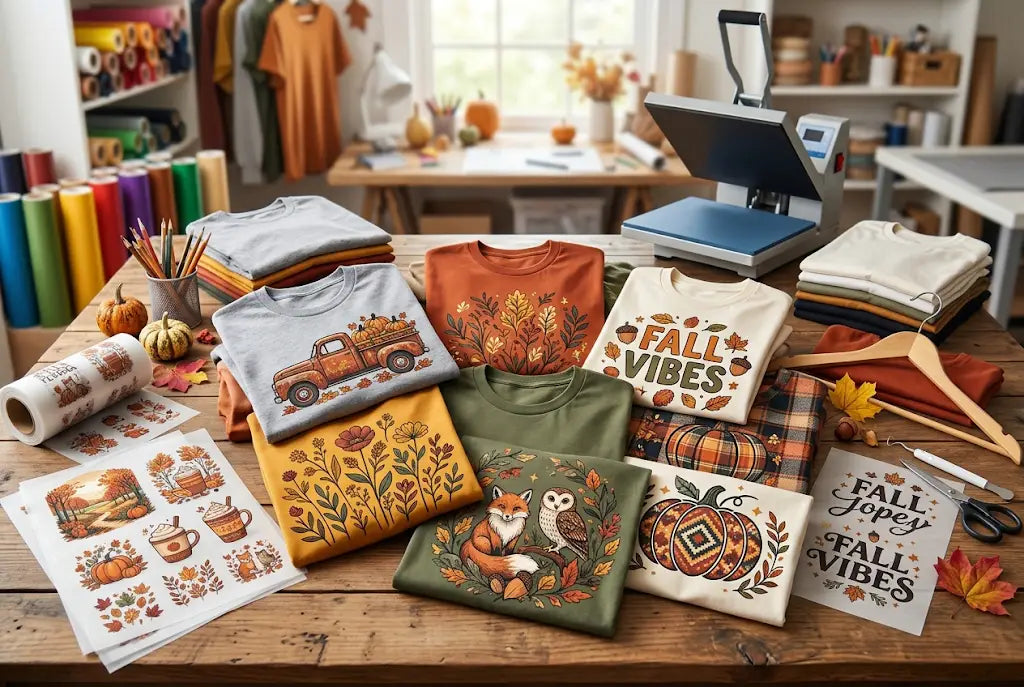
Most fall shirts do not fail because the art is bad. They fail because the wrong design ends up on the wrong buyer, at the wrong price, too late in the season. Fall is short. Buyers shop early, they buy fast, and then they move on to holiday.
Pumpkin shirt designs sell when they feel soft, warm, and easy to wear. DTF, which stands for Direct-to-Film, is the process where your design is printed onto a special film, coated with powder, and then pressed onto fabric. That film lets you test small, press fast, and reorder without holding boxes of printed shirts.
Which Fall DTF Transfer Designs Are Most Popular with Autumn Shoppers?
Autumn shoppers do not buy a shirt because it is trendy. They buy it because they can see themselves wearing it more than once. The designs that sell best are simple, warm, and easy to picture with jeans.
The Classic Pumpkin That Sells Every Year
A simple pumpkin with soft texture and warm orange still outsells most new designs. It feels familiar. And familiar sells.
- Keep the pumpkin simple: A clean shape reads fast from a few feet away.
- Use warm orange, not bright orange: Warm orange looks rich on cream. Bright orange looks like a costume.
- Use cream or oatmeal: Those blanks make the print feel soft and cozy.
This works well because classic buyers shop for themselves, for kids, and as gifts. One good pumpkin covers all three.
The Cute Pumpkin That Gifts Well
Cute pumpkin shirts sell to women, gift buyers, and anyone who wants a shirt that feels sweet without being childish. A smiley face, a small bow, or a tiny leaf is enough.
- Keep the face simple: Two dots and a smile is enough. More detail makes it look busy.
- Use soft colors: Soft orange, dusty pink, and cream feel sweet without shouting.
- Use a small chest print for a boutique feel: A small print feels more grown-up than a huge print.
And cute designs photograph well. A buyer who loves the photo is more likely to buy, and more likely to tag a friend.
The Funny Pumpkin That Sells Fast
Funny pumpkin shirts sell fast and burn out fast. A joke that lands in September feels tired by late October. That does not mean you should skip funny. It means you should order it small.
- Keep the phrase short: "Creep It Real" reads fast. A long joke gets skipped.
- Use black or charcoal: Dark blanks make funny art pop and make text easy to read.
- Use a bold font: A bold font reads fast at a market. A thin font gets lost.
So order 10, not 100. If 10 sell in a week, reorder. If 10 sit, you only lose 10 shirts.
How to Choose High-Demand DTF Prints for Different Customer Groups
One design does not fit every buyer. A family buyer wants a set. A boutique buyer wants calm. A festival buyer wants fun. Pick your buyer first, then pick the print.
For Families and Gift Buyers
Families buy sets. They want one design that works for adults, youth, and toddler. They want a photo that looks put together.
- Use the same art for all sizes: Same pumpkin, same color, same placement. That repeat makes the set look intentional.
- Price the set as a bundle: A bundle feels like a deal and saves you time on pressing and packing.
- Bring a size chart: A simple chart on your table cuts down on questions.
Pumpkin shirts for women often drive the family sale. She buys for herself first, then adds kids. If the women's tee feels good, the rest of the set follows.
For Boutique Buyers
Boutique buyers want calm, not loud. They want a shirt that mixes with the rest of their closet. They will pay more for a shirt that feels thoughtful.
- Use minimal art: A single pumpkin, a thin line leaf, or one short word. Less is more here.
- Use warm neutrals: Cream, sand, sage, and olive feel boutique-like. Neon does not.
- Show the capsule: Five tees that mix and match feel more valuable than ten random tees.
Boutique buyers also care about feel. If the print feels stiff, they put it back. A soft print sells. A stiff print does not.
For Market and Festival Buyers
Market buyers touch before they buy. They want to feel the shirt, see the color in daylight, and try it on. Festival buyers want fun and fast.
- Bring both chest and back prints: Some buyers want a small chest print. Others want a big back print.
- Bring hoodies, not just tees: A hoodie with the same pumpkin art often sells at a higher price.
- Shoot in natural light: Natural light shows true color. Shop lights lie about orange.
Market buyers are your best test. Watch what gets touched first. That touch tells you more than any trend post.
Which Fall Colors, Themes, and Graphics Drive More Shirt Sales?
Color is where fall collections win or lose. The right color makes a simple design feel premium. The wrong color makes a good design feel cheap.
Colors That Sell in Fall
We build fall around warm neutrals, not neon. Warm neutrals mix with denim, black, and plaid. Neon does not.
- Cream and oatmeal: Warm, soft, and easy to wear. Best for burnt orange, mustard, and olive art.
- Sand and taupe: A little deeper. Best for tone-on-tone art and botanical art.
- Sage and olive: Fresh and calm. Best for modern and botanical designs.
- Black and charcoal: Sharp and modern. Best for clean, one-color art and funny phrases.
- Forest green and washed brown: Rustic and warm. Best for vintage and harvest designs.
Check color in daylight, not just under shop lights. Hold the transfer up to the blank by a window before you press a batch. If the orange looks neon in daylight, it will look neon on the shirt.
Themes That Keep Selling
Themes matter more than trends. A theme that fits fall will sell from August through November. A trend will sell for two weeks.
- Pumpkin patch: A pumpkin, a patch, a family set. It sells to families and gift buyers.
- Pumpkin spice: A cup, a pumpkin, and a short phrase. It sells to coffee lovers.
- Harvest and botanical: Wheat, leaves, and thin line art. It sells to boutique buyers who do not want a loud fall shirt.
- Halloween light: A friendly jack-o-lantern, a tiny bat, a tiny moon. It sells to festival buyers without feeling scary.
Pumpkin spice shirts work well here because they sell from September through November. They are not just for one weekend.
Graphics That Read Fast
A graphic that reads fast sells fast. A graphic that needs explaining does not.
- Use one hero: One pumpkin, one truck, one cup. One hero keeps the shirt clean.
- Leave space around it: Space is part of the design. If the pumpkin touches the letters, the print looks crowded.
- Keep small text solid: Small letters get lost if you add texture to them. Keep them clean.
Fall graphic tees that follow this rule get asked about first. A buyer who can read the shirt from a few feet away is more likely to stop.
How to Create Profitable Autumn Apparel Bundles with DTF Transfers
Bundles sell more shirts per order. They also save you time on pressing and packing. And they feel like a deal to the buyer, without killing your margin.
The Family Bundle That Works
A family bundle is the easiest bundle to sell. It is one design, three sizes, one price.
- Pick one design: A classic pumpkin works best. It is the most versatile.
- Pick two colors: Cream and sand cover most families. Do not offer five colors for a bundle.
- Set one bundle price: A bundle price that is 10 to 15% less than buying three separately feels like a deal.
Families buy bundles for photos, for matching outfits, and for gifts. Make it easy. One price, one design, three sizes.
The Tee Plus Hoodie Bundle
A tee plus hoodie bundle sells to buyers who love a design and want it in two forms. It also raises your average order value.
- Use the same art for both: Same pumpkin, same color family, different blank. That repeat makes the bundle feel intentional.
- Price the hoodie higher: A hoodie uses more film and a higher-cost blank. Price it accordingly.
- Show the pair together: Photograph the tee and hoodie side by side. Buyers buy what they can see together.
This bundle works well for pumpkin patch shirt designs because the patch set feels like a collection, not just a shirt.
The Gift Bundle That Moves Slow Sellers
A gift bundle moves a slow seller by pairing it with a winner. It is a simple way to clear stock without discounting to zero.
- Pair a winner with a slow mover: A classic pumpkin plus a botanical tee. The winner brings the buyer in.
- Add a small extra: A care card, a sticker, or a simple gift bag makes the bundle feel thoughtful.
- Keep the bundle price clear: One price, no math for the buyer. If they have to calculate, they walk away.
Bundles are not about discounting. They are about making the buy easier. If the bundle is easy, the buyer buys.
Ready to order?
Upload your artwork and we'll take care of the printing with fast turnaround and dependable quality.
How to Price Fall DTF Transfer Shirts for Better Profit Margins
Pricing is not a guess. It is math, plus a little judgment about what your buyer will pay.
How to Price Without Losing Money
Add up everything, not just the blank. Many small brands forget packaging, returns, and time.
- Add film, blank, labor, and packaging: Film, blank, labor, and packaging are your real cost. Do not forget the bag, the tag, and the time to pack.
- Add a margin for returns: A few shirts will get returned or exchanged. Price for that.
- Price chest prints lower, full backs higher: A full back uses more film and more time. Price it higher.
- Price sets as bundles: A family set priced as a bundle feels like a deal to the buyer and saves you time.
For example, if a blank costs 6.50 dollars, film costs 2.25 dollars, and labor and packaging cost 3 dollars, you need to price that tee at about 19 to 21 dollars wholesale or 28 to 32 dollars retail to keep a healthy margin. Check blank prices each season because they shift, and adjust your price if needed. Verify costs with your supplier before you set a final price.
When to Hold Price and When to Discount
Do not discount too early. If you discount in September, you train buyers to wait.
- Hold price through September: Early buyers buy full price. Late buyers wait for a sale.
- Use a bundle offer in October: A bundle feels like a deal without killing your margin.
- Clear slow movers in November: By November, buyers are moving to holiday. Move slow stock then, not in September.
Pricing is also about confidence. If you discount a shirt on day one, you tell the buyer it was not worth full price. If you hold the price, you tell the buyer it is worth it.
DTF Promo Picks for Profitable Fall Drops
At DTF Promo, the drops that reorder most are three classic designs, two modern designs, and one funny design. That mix covers families, boutique buyers, and festival buyers. If you are building your first fall collection, start there. Add a second funny design only after the first one proves it can sell.
Where and How to Sell Fall DTF Transfer Apparel to Maximize Seasonal Sales
Where you sell matters as much as what you sell. A design that flops online can fly at a market. A design that flops at a market can fly in a boutique.
Selling at Markets and Festivals
Markets are about touch, color, and fit. Buyers want to feel the shirt, see it in daylight, and try it on.
- Bring both sizes and both prints: Some buyers want a small chest print. Others want a big back print. Bring both.
- Bring a mirror: A small mirror on your table lets buyers see the shirt on themselves. That mirror sells shirts.
- Bring a size chart: A simple chart cuts down on questions and keeps the line moving.
And bring hoodies. A hoodie with the same pumpkin art often sells at a higher price, and it feels more premium at a market.
Selling Online and in Boutiques
Online buyers cannot touch the shirt. They buy from photos. Boutique buyers buy from feel and from how the collection looks together.
- Shoot the shirt styled: A cream tee under a blazer, a sand tee under a cardigan, and a hoodie with jeans. Styled photos sell more than mockups.
- Shoot in natural light: Natural light shows true color. Shop lights lie about orange.
- Show the capsule: Five tees that mix and match feel more valuable than ten random tees.
Online, post early. Post your fall drop in late August. Early buyers buy full price. Late buyers wait for a sale.
How to Press So Prints Last
A good print should feel soft, not stiff. Press at 300 to 320°F for 12 to 15 seconds at medium-firm pressure. Let the shirt cool for 10 to 15 seconds, then peel in one steady motion. Do a second press with a cover sheet for 5 seconds to flatten edges. Wash test every new file. Press three samples, wash one after 24 hours, and compare it to an unwashed sample after five washes. A good fall print should survive 50 washes without cracking or peeling in our tests.
Final Thoughts
A profitable fall collection is not about having the most designs. It is about having the right designs, on the right blanks, at the right price, ready early. Start with six designs, build around warm neutrals, test with transfers, and reorder what moves. Keep 70% timeless and 30% trendy, price for margin, and show the shirt styled in real life.
That is how a small brand builds a fall collection that sells through, not one that ends up on clearance.
With DTF Promo, your collection stays ready to press with steady color and a soft, clean finish, so you can spend more time selling and less time fixing prints.
Frequently Asked Questions
What Pumpkin Shirt Designs Sell Best in Fall?
Classic pumpkins, cute smiley pumpkins, and short funny phrases sell best. Classic sells to families, cute sells to women and gift buyers, and funny sells fast at markets. Use warm neutrals like cream and sand. Press samples, watch what gets touched, and reorder what moves. That mix covers most fall buyers without leaving dead stock.
How Do I Choose Pumpkin Shirt Designs for My Shop?
Pick designs that fit your buyer, not just a trend. Classic pumpkins sell to families, modern minimal sells online, and botanical art sells to boutique buyers. Press one of each, post both, and watch which one gets asked about first. That answer is worth more than any trend post and will guide your next order.
What Colors Sell Best for Pumpkin Shirts?
Cream, oatmeal, sand, sage, olive, black, and charcoal sell best. They mix with denim and plaid. They make warm oranges look rich. Avoid neon orange for minimalist collections. Use burnt orange instead. Always check color in daylight, because shop lights make orange look warmer than it really is.
How Should I Price Pumpkin Shirts for Fall Markets?
Add film, blank, labor, packaging, and a margin for returns. Price chest prints lower and full backs higher. Price family sets as bundles. For example, a tee with a 6.50 dollar blank can sell for 28 to 32 dollars retail. Check blank prices each season because they shift, and adjust your price if needed.
What Are Good Bundle Ideas for Fall Shirts?
Family bundles, tee plus hoodie bundles, and gift bundles work best. Family bundles use one design in three sizes. Tee plus hoodie bundles use the same art on two blanks. Gift bundles pair a winner with a slow mover. Keep the bundle price clear. One price, no math for the buyer.
Where Can I Order Pumpkin Transfers From DTF Promo?
You can order through DTF Promo by uploading your artwork on the site. Choose your size, quantity, and turnaround, and your film will arrive ready to press. DTF Promo prints with steady color and clean edges, so you can focus on blanks, pressing, and selling instead of fighting your printer.
Does DTF Promo Offer Small Test Orders for Fall Designs?
Yes, DTF Promo supports small test orders, which makes it easy to try a classic and a modern design without buying a full run. Press one sample of each, wash it once, and see which one your buyers ask about first. If it sells, you can reorder the same art in larger quantities with confidence.
What Is the Difference Between DTF and Screen Printing?
DTF prints your art onto film, then you press it onto fabric. Screen printing uses screens and ink for each color. DTF is better for small runs, full color, and fast reorders. Screen printing is better for very large runs of one color. For small brands, DTF is often faster and more flexible.
How Should I Wash Pumpkin Shirts With DTF Transfers?
Wash inside out in cold water and tumble dry low or hang dry. Avoid harsh bleach and high heat, which can fade colors and make film brittle. Give buyers a small care card with those steps. Clear care instructions cut down on complaints and keep the shirt looking good after many washes.
When Should I Launch My Fall Shirt Collection?
Launch in late August for early buyers who pay full price. Post your drop, shoot styled photos, and reorder what moves. Hold your price through September. Use a bundle offer in October if you need to move stock. By November, buyers are moving to holiday, so do not wait to launch.