
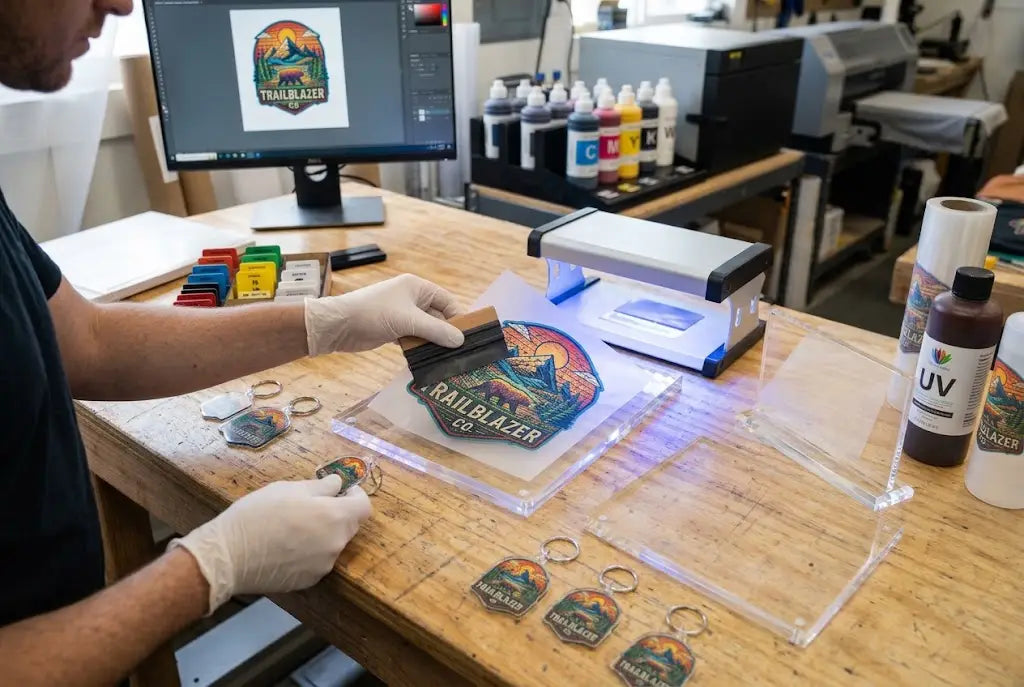
UV DTF transfers on acrylic are UV-cured ink prints that come on a carrier film with a strong adhesive backing and transfer as a solid, raised decal. UV DTF stands for ultraviolet direct-to-film, meaning the ink is instantly hardened with UV light to create a scratch-resistant print.
For acrylic, this matters because acrylic has low surface energy and rejects regular vinyl. You need that aggressive adhesive and cured ink layer to get a bond that lasts on keychains that live in pockets and signs that sit in sun. When prepped right, these prints hold 2 to 3 years outdoors.
UV DTF Transfers on Acrylic: Why Acrylic Rejects Bad Transfers
Not all acrylic is the same. Cast acrylic is made by pouring liquid between glass plates. It has higher surface energy and takes UV DTF transfers on acrylic beautifully. Extruded acrylic is made by pushing plastic through a roller. It's cheaper, has lower surface energy, and is prone to bubbling and edge lift.
If you're buying UV DTF acrylic blanks for crafts or corporate awards, ask your supplier if it's cast. Cast costs about $0.20 to $0.40 more per blank but your failure rate drops from 15% to under 2%. For promo distributors doing 500 keychains, that's 75 fewer remakes.
How to Prep Acrylic So It Actually Holds
This is where 80% of failures happen. Acrylic ships with a protective film, and that film leaves behind silicone residue you can't see. You also have static that pulls dust from across the room.
First, peel the protective film off slowly right before application, not an hour before. Wipe the surface with 90%+ isopropyl alcohol using a lint-free microfiber. Do it twice. The first wipe removes oils, the second removes the haze. Don't use glass cleaner. Most contain anti-static additives that hurt adhesion.
For UV DTF acrylic blanks that will be handled a lot, like keychains, hit it with an extra step. Wipe with alcohol, then use a tack cloth lightly over the surface. You'll pick up the last dust particles that cause fish-eyes. Let the blank sit for 60 seconds to flash dry. It should feel squeaky clean.
How to Apply UV DTF Transfers to Acrylic Without Bubbles
Acrylic is non-porous. Air has nowhere to go, so you have to push it out. This works well because you're working on a hard, flat surface, so you can use more pressure than you can on glass.
Position your custom UV DTF transfers for acrylic and tack one edge down lightly so you can reposition. Once aligned, press from the center out with a felt squeegee using firm, overlapping strokes. You want to hear a slight scratching sound. That's pressure. Do three passes.
Now peel the carrier film at a low 180-degree angle, keeping it flat to the surface. Go slow. If any small letter lifts, lay the film back down and squeegee that spot again for 10 seconds. For acrylic keychains under 2.5 inches, you can use your thumb instead of a squeegee to feel the edges better.
One more thing. Don't stretch the film. UV DTF film has zero memory stretch. If you pull it to fit, it will pull back later.
UV DTF Acrylic Blanks for Crafts vs Corporate Blanks
Craft blanks from Amazon and promo-grade blanks are not the same product. Craft blanks are often extruded, 1.5mm thin, and bow when you squeegee hard. Corporate blanks are cast, 3mm to 6mm thick, and stay flat.
For awards and office signs, use 3mm or thicker. Anything thinner warps under overhead lights over time. For keychains, 3mm is the sweet spot. It feels premium but still fits standard hardware. Cost difference is real. A 2-inch extruded circle is $0.18 to $0.25. A cast circle is $0.38 to $0.55. But when you're charging $6 to $12 per custom keychain, the extra $0.20 saves you a replacement.
Temperature and Humidity Control That Saves Your Run
UV DTF transfers for acrylic like room temperature. Ideal is 70 to 75°F and 40 to 50% humidity. Below 65°F, the adhesive is stiff and doesn't flow into the micro texture of the acrylic. Above 60% humidity, you get an invisible moisture layer that causes delayed bubbling.
If you're in a warehouse in summer, run a dehumidifier near your application table. Cold acrylic that sat in a delivery truck overnight should sit indoors for 2 hours before you apply. We see this every winter. Shops apply to cold blanks and call us two days later because the edges have lifted.
Why Your Edges Lift and How to Fix It at DTF Promo
Edge lift on acrylic is almost always contamination, not bad glue. Hand oil, dust from cutting acrylic, and static are the culprits.
After you laser cut or CNC acrylic, the edge has acrylic dust that migrates to the face. You must clean after cutting, not just after peeling the mask. Also, change your gloves. Cotton gloves leave lint. Use nitrile.
If you're doing outdoor signs that will see sun and rain, edge seal is worth it. A thin line of clear UV-resistant edge sealer pen around the perimeter adds about $0.03 per piece in labor and extends outdoor life from 12 months to 24+ months. For indoor awards, you don't need it.
How to Price and Sell UV DTF Acrylic Products
Here's real math promo distributors use. A standard 2x3 inch acrylic award blank at 3mm cast is $0.90 to $1.40. A UV DTF transfer for that size gang printed is $0.45 to $0.75. Labor to apply and add hardware is $0.50. Total cost $1.85 to $2.65. They sell for $12 to $25 as a custom desk award.
Keychains are even better. Blank $0.40, transfer $0.25, hardware $0.15, labor $0.40 = $1.20 total. Sell at $5 to $8 in quantities of 100. That's a 75% margin. That's why custom UV DTF transfers for acrylic are taking over vinyl in the promo world. No weeding, full color, and faster application at 45 to 60 seconds per piece once you're in rhythm.
How to Handle Clear Acrylic Without Seeing Fingerprints
Clear acrylic shows everything. Every bubble, every speck, every fingerprint behind the print is visible from the front.
Work with the blank on a black mat so you can see dust. Wear nitrile gloves on both hands. Apply in a still room with no fans blowing. And here's a pro trick. Apply your UV DTF acrylic transfer, then flip the blank over and inspect from the front with a light behind it. You'll catch micro bubbles you missed.
For double-sided clear awards, apply one side, let dwell 30 minutes, then apply the other side. If you do both at once, the pressure from the second side can bubble the first.
How to Store Transfers So They Stay High Tack
UV DTF transfers for acrylic lose tack when stored wrong. Heat is the enemy. A box sitting near your heat press at 95°F will degrade adhesive in two weeks.
Store flat, in original sleeve, at 65 to 75°F, out of sun. Don't stack more than 25 sheets with weight on top. That causes blocking where adhesive sticks to the liner. Fresh film printed within 30 days gives you the strongest tack. At DTF Promo we print on 24 to 48 hour turnaround so you're not getting old stock.
Conclusion That Makes Your Acrylic Work Sellable
UV DTF transfers on acrylic work because they solve the three things that killed vinyl on acrylic. No weeding, real opacity on clear blanks, and an adhesive that actually bites into low-energy plastic.
But acrylic will punish sloppy prep. Clean twice with 90% IPA, use cast blanks for anything corporate, squeegee hard from center out, peel low and slow, and give it 24 hours to dwell. Do that and your keychains won't peel in pockets, your signs won't bubble in windows, and your awards will look like they came from a factory, not a craft table.
For promo distributors, this is your edge. You can now offer full-color, photo-quality acrylic merch with no minimums and fast turns. At DTF Promo, we gang your mixed designs to maximize your sheet and check every file for acrylic readiness before we print.
Frequently Asked Questions
How Do You Apply UV DTF Transfers on Acrylic Keychains Without Bubbles?
Clean the blank twice with 90% IPA and a lint-free cloth, then use a tack cloth. Position the transfer, squeegee firmly from center out three times, and peel the carrier at 180 degrees slowly. Work at 70 to 75°F. For small keychains, use thumb pressure to feel edges. Let dwell 24 hours before adding hardware.
Can You Use UV DTF Transfers on Acrylic for Outdoor Signs?
Yes, UV-cured ink is rated for 3 plus years outdoors. On cast acrylic with proper prep, it holds 24 months outside without fading or peeling. Use 3mm or thicker blanks and seal edges with a clear UV-resistant pen for best results. Extruded acrylic may yellow and cause edge lift sooner.
What Is the Difference Between Cast and Extruded Acrylic for UV DTF?
Cast acrylic is poured between glass and has higher surface energy, so UV DTF sticks better. Extruded is rolled and has lower energy and more internal stress. Cast costs $0.20 to $0.40 more per blank but cuts failure rate from 15% to under 2%. Always choose cast for corporate awards and promo.
Do You Need Adhesion Promoter for UV DTF Acrylic Blanks?
For most cast acrylic blanks, no. High-tack UV DTF adhesive is enough when prepped with IPA. For extruded acrylic or recycled acrylic, a light wipe of acrylic adhesion promoter can raise surface energy and improve bond by 40%. Test on scrap first because some promoters cloud clear acrylic if over applied.
How Long Do Custom UV DTF Transfers for Acrylic Last on Keychains?
With proper prep and 24-hour dwell, UV DTF on acrylic keychains lasts 18 to 30 months of daily pocket use. The print itself is scratch resistant to 4H pencil hardness. The failure point is edge lift from drops, not ink wear. Using 3mm cast blanks and rounding sharp corners reduces chipping significantly.
How Much Does It Cost to Print UV DTF Transfers for Acrylic?
Market pricing for 2025 to 2026 is $18 to $28 for a 22x24 inch gang sheet. Per design cost for a 2-inch keychain is $0.20 to $0.35, and a 3x5 inch sign is $0.70 to $1.20. Verify pricing on supplier sites as film and ink costs change. DTF Promo prints gang sheets with free layout optimization.
Can You Put UV DTF Transfers on Acrylic Blanks for Crafts From Amazon?
You can, but check thickness and type. Many craft blanks are thin extruded acrylic that bows and bubbles. Look for listings that say cast acrylic and 3mm. Clean off mask residue twice with IPA. UV DTF acrylic blanks for crafts work fine for indoor ornaments but not for high-end corporate awards.
Why Are My UV DTF Acrylic Transfers Peeling at the Corners?
Corner peel is usually dust or oil under the edge or film that was stretched to fit. Corners are the first place contamination shows. Re-clean with IPA, avoid touching adhesive, and don't pull film to align. If corners still lift, your blanks may be extruded or have silicone from the protective mask.
What Temperature Is Best for How to Apply UV DTF Transfers to Acrylic?
Best is 70 to 75°F blank and room temp with 40 to 50% humidity. Below 65°F adhesive is stiff and won't bond. Above 60% humidity you get invisible moisture that causes delayed bubbles. Warm cold blanks indoors for 2 hours before application. Don't use heat guns directly on acrylic, it can warp thin blanks.
Does DTF Promo Offer Gang Sheets for UV DTF Transfers on Acrylic?
Yes, DTF Promo offers 22x12, 22x24, and 22x60 gang sheets optimized for acrylic. We adjust adhesive tack for cast vs extruded blanks and check your files for transparent backgrounds and 300 DPI. Upload your art and note blank type and we will nest for maximum yield with free layout review.